Recently in Westminster Category

Thanks again to Tom Harris for agreeing to swap blogposts on this issue: he's posted both here. I've added mine below as well.

tomharrispic.JPG
THE TRULY tragic case of the three asylum seekers who committed suicide by throwing themselves from the high-rise block of flats in Glasgow has resurrected the debate on our asylum system.

We still don't know enough about this specific case to be able to make a judgment as to what actually occurred and why. The media have, at various points, described the deceased as Russian and Kosovan. 

One report suggested at least one of them was suffering from severe mental illness. They may or may not have successfully claimed asylum in Canada before arriving in the UK.

The fact is we don't know how much, or if any, of this is true. And it would be irresponsible in the extreme, in the meantime, to make hysterical accusations based on rumours and speculation.

Which is why, presumably, Robina Qureshi has been all over the Scottish media doing just that.

Robina, with whom I've crossed swords before, is the director of a branch of Solidarity housing "charity", Positive Action in Housing, who provide support to failed asylum seekers in Glasgow. Yesterday, in the immediate aftermath of the terrible news breaking, she told The Times that "if the suicides had anything to do with the Border Agency telling the victims that they could not stay in the country, then the agency was culpable".

But despite her qualifying her own conclusions with that "if", she organised a demonstration outside the Border Agency office in Glasgow today, telling Radio Clyde and anyone else who would listen that what happened in Springburn was a direct result of official threats to return the asylum seekers home. She's also called for a public inquiry, although since she's already decided what the facts are, I'm not sure why she needs one. If Robina had her way, every claim for asylum should be awarded and public servants who enforce the law are barbarians.

She also said:

We believe there should be a public inquiry into these deaths, and the impact of the UK Border Agency and its terror campaign - disguised as asylum policy - on the lives of asylum seekers who have lived here for years.

Yes, many of them have lived here for years - illegally and after being told repeatedly thattheir asylum claim had been rejected because there was no threat to their safety in their home country. And by describing asylum policy as a "terror campaign", Robina is demonstrating why no-one other than a few gullible hacks take her seriously.

Even the normally sensible James Mackenzie, who works for Holyrood's two Green MSPs, accused me of a lack of compassion in the comments I made to The Times. Fair enough. I've been dealing with this  issue too long to expect people to approach it objectively and without  recourse to emotive language (see his guest post above).

Even if it emerges that the deceased threatened officials with suicide if they attempted to remove them, surely that threat could not be allowed to be a veto over legal process?

When phoned by The Times yesterday, I knew I couldn't talk about this specific case - apart from the fact that we didn't really know what had happened, the deaths didn't happen in my constituency - but agreed to talk about general asylum policy.

But until the facts, rather than speculation and rumour, hold sway, it would be most unwise to make subjective judgments about this case, however tempting it would be for some to try to make political capital on the back of such a human tragedy.

As for asylum policy in general, my view, having dealt with hundreds of cases since 2001, is very clear: an asylum policy differentiates between those who have a genuine reason to fear persecution in their home country, and those who simply want to live in the UK in order to attain a better quality of life. Those who fall into the latter category must apply through the immigration route. To award refugee status to everyone who claims it would catastrophically undermine its very notion. It would result in an "open-door" immigration policy, and no-one seriously wants that.

_________________

Labour pandering to dog-whistle politics on asylum

Nothing tells you more about a government than how it treats the vulnerable, especially those who cannot vote. Labour's most striking domestic failure of this sort has been their approach to people fleeing persecution and torture: successive Home Secretaries since 1997 have sought ever more uncompromising ways to make their lives harder once they get here.

Very few of us will have experienced the kind of mistreatment which is commonplace amongst those seeking asylum. I'm not in danger of being arrested for being in the wrong political party, like my Green colleagues in Rwanda and China are. My family don't come from a marginalised group being subject to ethnic cleansing. I don't know anyone who's seen family members executed for attending peaceful anti-government protests. 

But do the thought exercise: what if that had happened? If Scotland had become as brutal and lawless as the Democratic Republic of Congo, if state-sponsored "disappearances" or a round of ethnic cleansing had begun here, I'd want to know I could seek sanctuary in India or Ireland or Indonesia and have my case taken seriously.

And in those circumstances, I wouldn't want to be spat at in the street or forced to present stigmatising vouchers in supermarket queues to buy the basics. If the Scottish expat community was in Delhi, I wouldn't want to be forcibly settled in Varanasi. It would mystify me to be told I couldn't work and contribute, then read Government Ministers complaining that I'm somehow scrounging off the hard-working locals

If I had kids, it'd fill me with despair to see them locked up in adult detention centres and subjected to levels of brutality that would inevitably remind me of what we'd all been though in the first place. If I'd had Kafkaesque bureaucracies ranged against me at home, a life of endless forms and interviews in a foreign language without proper legal support would seriously jeopardise my mental health: imagine if an irritating call-centre also had the power to deport you back into danger, or if they sang racist songs at you mocking your plight

Yet all of this is the reality of Labour's asylum policy, the legacy of their thirteen years in government. No Daily Mail headline has gone un-pandered to, no dog-whistle to racist voters has gone un-blown - and waiting in the wings is a Tory administration that backed every last clampdown. It's not a casual or frivolous decision to leave your home country and come here to face racist abuse, to become a stock figure of hate for tabloid editors and the politicians who love them, but there is no softer target to demonise, not even those "feral children" we are also encouraged to fear and hate.

Yes, we need a system which checks individuals' claims, not one which accepts everyone who just says the magic word. But the priority with this system should be to ensure no-one gets sent back to face torture. The price of someone without a decent claim being accepted by mistake is low if unfortunate, but the price of a false rejection could be someone's life. The system should move quickly to a fair decision, but we should bend over backwards and help those who apply to make their case. 

We Scots fancy ourselves (especially in our Tartan Army incarnation) as responsible visitors to other countries, and like to think of this as a welcoming country. In many ways it is, but without an end to Labour/Tory domination of asylum policy this will never be the whole truth.

Bending guillemots.

| | Comments (0)
birdspoons.jpgA star comes to North Berwick this weekend, and I'm sorry I won't be there. Uri Geller, best man to the late Michael Jackson, cutlery-influencer extraordinaire and regular litigant, is in town to talk utter nonsense about his psychic powers. 

Just over a year ago he bought The Lamb, a wee island in the Forth off the East Lothian coast. He reckons it's "one of the Great Pyramids of Scotland". Mmm.

Now he's coming to the Seabird Centre to give a talk and also, according to the Courier, staying on the Lamb, presumably in a tent. If he actually manages to land, which seems unlikely, I advise any actual seabirds he encounters to hide their cutlery. If anyone's going to the public Q&A perhaps they could also ask him why he claims to have ensured Scotland's exit from Euro 96

No chance.

| | Comments (0)
It's understandable for party campaigners to project confidence, but sometimes it's simply dishonest. Take the Lib Dems in Edinburgh North and Leith. 

On Twitter this morning, Andrew Reeves, their Director of Campaigns, claimed in a comment to Tom Allan, the Guardian's new microblogger, that (update: formerprofessional airport apologist Kevin Lang was "set to win the seat".

I disagree. I am confident that the Liberals will win just one Edinburgh seat - Edinburgh West. I'm not sure it's legal to make private bets, but, if it is, I'd be happy take all bets from them to the contrary on any of the other Edinburgh seats. My guess is that the money wouldn't go where the mouth is.
Michael Foot, whose death is being reported today, lived an extraordinary life, with his reputation unfairly weakened by Labour's 1983 election loss under his leadership. It's almost implausible to consider how far back his influence stretches, but I was struck by the note from George Orwell's diary from more than 70 years ago. 

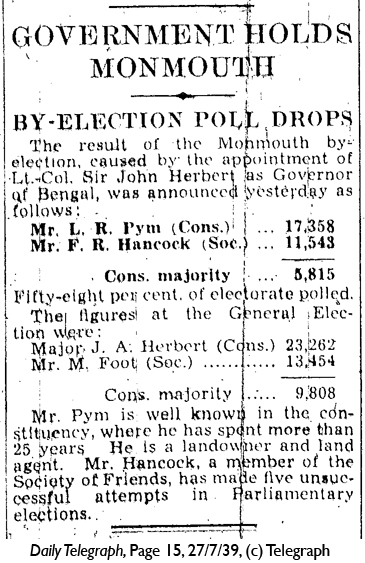
It cites the defeat of a Socialist candidate in the July 1939 Monmouth by-election, and notes that Mr Foot had fought the same seat in the 1935 General Election. The Telegraph's snippet on it is below.
monmouthfoot.jpg

2003 all over again?

| | Comments (3)
2003MSPs.jpgThe poll in today's Scotland on Sunday has been discussed elsewhere, but not the Holyrood regional voting intention. It's the best bit, and Kenny F sent me out to the shops this morning especially for it.

Holyrood constituencies (2007 result in brackets)
Labour: 33% (32%)
SNP: 28% (33%)
Conservative: 16% (13%)
Liberal: 16% (14%)
Others: 6% (8%)

Holyrood regional
Labour: 31% (29%)
SNP: 26% (31%)
Conservative: 17% (14%)
Liberal: 14% (11%)
Green: 7% (4%)
Others: 6% (11%)

By Scotland on Sunday's calculations (and mine) that would put us up to seven Green MSPs again. The pic shows what that looked like last time. It's a crude summary, but if this were the actual vote shares in May next year, we'd get a result roughly like the 2003 election, except where the six former SSP MSPs were replaced by the SNP. The obvious post-election arrangement would be another Labour/Liberal coalition, too, although Labour have watched the SNP's minority administration enviously.

Cheering as this poll may be for Greens, it's even more A Bit Of Fun than usual. No Holyrood voting intention will be any kind of worthwhile prediction until the UK election results have bedded in. Will Cameron woo or alienate Scots? Could Gordon Brown even hang on? Might the Liberals get the hung Parliament they crave? Could an AV referendum become a true PR election? Might UKIP get beaten by the Monster Raving Loony Party?

The Holyrood polls will start to get properly gripping for anoraks from September, by my calculation. One last factor which might make a difference is Brighton Pavilion. I'm heading down on Friday to help Caroline Lucas get elected. It should be fun, as well as virtuous, and, if she wins, the extra profile for Greens nationally could help us out in 2011 too.
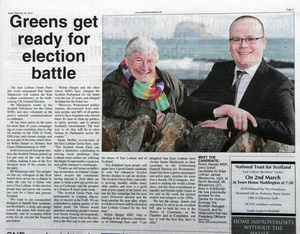
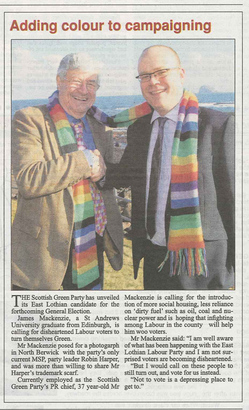
The rumours are true. My colleagues in East Lothian have selected me as their candidate for Westminster, and I persuaded Robin to come out on Monday to help me launch the campaign at the Seabird Centre. 

The local papers gave us some great coverage, with colour pics in both the East Lothian News and the East Lothian Courier (click below for larger images). It's now time to reveal the secret of our success over the last ten years, which is simply Robin's trademark scarf. Colour pictures are much more eye-catching, and you can't use a black'n'white shot of the scarf. Seriously, it's media magic.

ELN.jpgELC.jpg
The keen-eyed amongst you will notice I don't live in the constituency, but at least one other major party candidate stays further away than Edinburgh, so I'm hoping not to be in the firing line of too many League of Gentlemen type leaflets

And it is a fascinating part of the world: socially diverse, with ex-mining communities, surfers and wealthy commuters to Edinburgh. It's also home to an awful lot of infrastructure and industry, especially energy. Older members of the Scottish Green Party have bittersweet memories of the campaign against Torness, so it's a curious honour to be able to campaign against nuclear power in this constituency. Labour, of course, remain ultra-loyal to nukes, and I'd point you to an article I wrote in 2008 about the relationship Anne Moffat and Iain Gray have with the plant.

We have a small but very committed branch locally, who led our successful campaign to block ship-to-ship oil transfers in the Forth, something we finally secured through an agreement with the SNP in May 2007. A good wee campaign in the area should help drum up some more members and activists, and help us return a Green MSP for South in 2011 and local councillors in 2012.

Thanks also to Malc, Jeff and Stephen for their kind words, although, as Stephen says, "I obviously won't wish James too much luck". He put the 2005 result on his blog, and that was indeed the last time the seat was contested. 

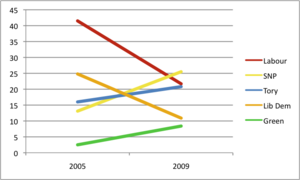
However, a lot's happened since 2005 (including a change of Scottish Government and the SNP's subsequent difficulties, as well as Labour's loss of the plot nationally and locally). We also know how most of the seat voted in last year's Euros (although the Westminster seat includes Musselburgh too).

Another problem with the following graph is that it compares a non-PR election with a PR one, and we do better when elections are fairer. One might expect the Lib Dems to do so as well, though, but like Labour, their vote roughly halved between 2005 and 2009. Those caveats out of the way..

EL.png
One thing I won't say, though, is this: only Greens can win here. But I'm certainly going to enjoy the contest.

Tories float a good idea.

| | Comments (0)
carriersinking.jpgIt's not often I agree with the Tories on defence, with Labour and the Lib Dems on the other side. The Tories, it seems, are getting ready to save the £3.5bn it would cost to build two new aircraft carriers. It's all a bit implicit, sure, but even to be considering this is major progress.

These projects are only ever defended as job-creation schemes, even though the same money could create far more jobs doing something actually useful. 

I understand that: people need to work, and the unions' position is entirely defensible. Unlike an aircraft carrier, or Labour/Lib Dem defence policy.

An extraordinary position to be in.

| | Comments (4)
carolineagain.jpgDon't believe the politicians when they tell you "only X can win here", with or without dodgy bar charts. Proper polling should be listened to, of course, but the bookies are perhaps the most reliable source of intelligence. 

They put their money where their predictions are, after all, which is one of the reasons Political Betting is such a popular site.

When I joined this movement in 1998 I would have struggled to believe that in little more than ten years our sister party would be odds on to win a Westminster constituency. Yet Ladbrokes offer the following national odds:
Green Party to win a seat - 5/6

Despite the prospects in Norwich South, where Greens have topped local election results each year since 2007, most of this is because the bookies rate Caroline Lucas the favourite for Brighton Pavilion. She's at evens, followed some way behind by the Tories at 7/4, then Labour at 3/1 and the Lib Dems at 66/1. 

The party did an ICM constituency poll at the tail end of last year, which gave this result:

Green: 35% (+13%)
Tory: 27% (+3%)
Labour: 25% (-10%)
Lib Dem: 11% (-6%)
Others: 2%

The main local politics blog credits Greens with the momentum, the Independent have today more or less called it for Caroline, and the paper came canvassing with her at the weekend. Political Betting discussed the poll over the holiday too.

There's no sign of local complacency either - the whole constituency gets a visit every month, and Greens from across the UK are helping out. I'm looking forward to a trip down before the end of March, and I know many others are too. Better to win one seat than to come closer in a few more.

If you're looking for betting value on Greens, though, I'd go for Norwich South at 4/1 or Edinburgh East at a whopping 100/1. Robin's represented the area for a decade, after all, and you only have to walk the streets with him to see how well known he is.

Lagging behind.

| | Comments (1)
warmscotland.pngLast year, regular readers will know, the Green MSPs proposed a massive national insulation programme to cut household bills, help tackle climate change, and boost jobs. The signals from Ministers were positive until the final hour, then it fell apart. 

It had become clear that the SNP were going to stick to the same old New Labour means-tested approach, despite all the evidence it wouldn't work. 

They were also convinced that we were bluffing about the need to take a more radical approach, and instead they listened to the siren voices arguing for business as usual. The Budget duly fell, and then, because they didn't need Green votes the next time round, they just did the bare minimum to make it look like they'd been listening.

Subsequently, to nobody's great surprise, it became clear that their timid mini-programme was indeed destined not to deliver, nor would their related loans programme, also promised during the Budget.

Since then WWF have published a fascinating report on proper free area-based loft and cavity work (full report as pdf here). The report draws on three well-run schemes, delivered in Hadyard Hill, Girvan and Fintry.

It shows that it cost £1 to allow householders in these three communities to save £1 on energy bills - remember that's a recurring saving. The Warm Deal, the Scottish Government's precursor to the Energy Assistance Package, cost almost two and half times as much to give similar savings.

The main argument against our approach is a seductive one: we should target the fuel poor, and make insulation free for those on benefits or over a certain age. Surely that'd be the most efficient use of money? It sounds it, until you remember that climate change is also an important objective here.Furthermore, in these three places WWF found that between 21% and 69% of all those in fuel poverty wouldn't have met the Scottish Government's criteria, and they'd have had to pay.

The only way that information was discovered is because these schemes were open to everyone. It has to be the way, at least for the cheapest and most cost-effective measures. There's a lot more in the report, and I really recommend it.

The strange thing about last year's Budget was the sheer scale of the opportunity missed by the SNP. Labour's efforts in London have been ineffective means testing, and they had a chance to show they could run Scotland better. They had the powers, and they flunked it. It would have been theirs, not ours: their signature achievement to go into the next election. Who knows what that will be now? I think failure to get the referendum through is a poor substitute.

The model we're proposing, was perhaps counter-intuitively implemented by a minority Tory council, in Kirklees (aka Greater Huddersfield). Dave Cameron noticed, and he launched his next local election campaign there.

He's not forgotten, either. His scheme, announced today to show Labour up during Copenhagen, is on an ambitious scale, albeit with some obvious flaws in it (Tescos and M&S probably aren't the best partners). But compared to the Tories, it's not just Labour who are lagging behind. The SNP are too.

Tom Harris in "wrong on PR" shock.

| | Comments (1)
TomHarris.jpgYou can't argue with the quantity of blogging that Tom Harris puts in, but he will insist on being wrong. Today's egregious example is on the topic of proportional representation. 

It's perhaps no surprise that someone on the hard right of the Labour Party would oppose fairer elections, and it's also pretty clear why the Scottish Parliament as a whole gets up his nose.

The issues MSPs discuss and decide upon at Holyrood tend to be the main issues of the day: there are exceptions, sure, like the economy, welcoming asylum seekers, and whatever wars Labour's gotten us into lately. Scottish MPs just don't get the limelight any more, and that must sting, especially for an ex-Minister.

Today Tom weighed in against his colleagues' doomed PR for Westminster plan, which is about twelve years too late. "In Scotland and Wales", he opined, ""assisted places scheme" MSPs and AMs represent no-one.."

In fact, Tom, 73 MSPs are elected in a relatively undemocratic manner, usually by a minority of their constituents. First Past The Post "assists" these Members, especially those like Kenny Gibson, who won his seat last time with just 30.7% of the vote. Conversely, 56 of our MSPs are elected to reflect that radical thing: the will of the electorate.

Thanks only to the PR element, the numbers of MSPs in Holyrood aren't that far from the popular will, but those 73 less democratic elections do skew things. The SNP got 33% of the constituency vote and 31% of the regional vote, but 36% of the MSPs. Labour got fewer votes in both, but still picked up 34% of the seats. Conversely, Greens got 4% of the vote and just 1.5% of the seats. 

If we had to abolish one kind of MSP, Tom's preference is clear: he'd get rid of the more representative kind. I can't agree.

The cost of power.

| | Comments (2)
nothanks.jpgSuddenly, as impotence looms, Labour have gone nuclear in a major way. They aren't really making a decision, they're just clearing the way for the Tories to do so, and guaranteeing that Her Majesty's Loyal Opposition will sit idly by after the election.

Nuclear remains, of course, uneconomic, which is why no stations have been built here since the dog days of the last Tory administration. If Ministers want it, we'll have to pay. The Telegraph confirms that: an average household bill will go up by £227 if this goes ahead.

Meanwhile, over at the Times, they're telling us we'll also be soaked for the £9.5bn cost of carbon capture and storage, which currently doesn't work anywhere. That's just a starting estimate based on 15 years' worth of levy, but the final figure could be twice that over 30 years. 

If we're going to pay out massive sums to support our future power needs, why on earth won't Labour, the Tories or even the Lib Dems push effective clean energy rather than these costly technological dead ends?

From a small base.

| | Comments (3)
ComresOctScot.pngA Comres poll for the Independent today shows a pleasingly tiny proportion of BNP voters despite the BBC giving them the biggest publicity spree in their history. 

As Mike Smithson puts it, "The mid-October poll had 8 respondees saying BNP - tonight's survey has that at 13". That's out of 1004 respondents. 

The same poll shows the Greens on 5% nationally (the actual final results are on p22 of that massive pdf), which is pretty promising for Green target seats given the large variability in our vote. 

Deep in the lengthy tables for it I noticed something else interesting. It's a subsample point, and I have in the past criticised those who take those too seriously. Nevertheless, it confirms my prejudices, so it's worth blogging about.

Comres asked their respondents "Generally speaking, do you think of yourself as ...?", i.e. Labour/Tory/Lib Dem/Green/Nat etc. Page 18 shows the results, or click the image above for a look at it.

In Scotland, a quarter define themselves as Labour, with almost as many as identifying as Nats. Despite the better position of the Nats, this makes sense. I know plenty of people who'd still say they think of themselves as Labour people but won't vote Labour, whereas the SNP clearly continue to get the backing of swing voters.

16% identify as Tories, about the level they poll at, pretty much whatever happens. This also seems to make sense. Their base is firm, if much lower than the rest of the UK for some reason, but they pick up few floating or tactical voters.

Then, intriguingly, 6% of this small sample of Scots define themselves as Green, and 6% as Lib Dems. The Lib Dems do continue to poll above us for now: for instance, in the recent Euros they got 11.5% to our 7.3%. 

With some chameleon-like politics, squeeze messages and media omnipresence, they do a lot with pretty low base. Those 5-10% who vote Lib Dem but don't identify with them, though, there's a term for them. Potential Green voters..

Why votes at 16 matter.

| | Comments (15)
youthvote.jpgI've got in my hand a flyer given out by Scottish Youth Parliament activists on the Gude Cause suffragette march the weekend before last. It lists what sixteen- and seventeen-year-olds can do, or can be made to do. 

They point out that this age group can be tried in court as an adult, join the army, own their own home, and pay taxes, but not vote. 

It's a persuasive argument, even if discrimination against the young is in one sense more egalitarian than discrimination against women or members of ethnic minorities. We were all young once, even Bill Aitken.

The reason I'm so committed to this cause is a little different, though.

Last year we had a young man in our Holyrood office on a work placement arranged by his school. These can be a bit high maintenance and sometimes of dubious value, but he was smart as hell, immediately got the basics of writing a press release, and fitted in from the start. He was also very politically aware, and pretty passionate.

He was fifteen at the time, and he had done the sums. He knew he'd turn eighteen in 2011, just a couple of months after the next Holyrood election, and wouldn't get a say in a Scottish election until he was practically twenty-two, seven years away.

Another very good friend of mine is in a similar position. He'll be a year and a month too young to vote in the 2011 elections, and (assuming the next UK cycle is four years long) he'll be in his twenties before he gets to vote either for Westminster or Holyrood. He'll just miss the 2012 Scottish locals, too, so won't get to vote for his local councillors until he's almost twenty-three.

Like our work placement friend, he's very politically literate, very knowledgeable and passionate about the issues. But politicians can safely ignore him as long as the voting age remains at eighteen.

The idea you can vote at eighteen is, after all, awfully contingent on there being an election on your eighteenth birthday, and the current arrangement means a lot of people in their twenties will have had no opportunity to vote for at least one of the levels of government that matters. Just wrong.

"Votes at sixteen" is therefore slightly misleading, although I see why they chose it. Plenty of people much older than that will get disenfranchised too, and the problem is much wider than people normally think.

Some patronising fools claim we can't trust these young people to vote responsibly. Just as with the older generations, though, many of those who don't care or don't know anything about politics simply won't vote at all. And who are we to say what a responsible vote is anyway? Let the (young) people decide for themselves.

Greens : Nats :: Nats : Tories?

| | Comments (10)
equations.jpgAlex Salmond is away this week at the Alex Salmond Annual Conference 2009, and everyone sounds like they're having a lovely time counting their chickens ahead of the UK General.

The Maximum Eck therefore went on GMS this morning to set out his strategically sensible but odd-sounding ambition for this election: a hung Parliament. 

Brian Taylor captures the thinking perfectly. The comparison to Steel's "go back to your constituencies" line may be brutal, but, as BT observes, this approach is much smarter because it excuses Salmond from having to admit he'd love nothing more than a Cameron victory. Apart from a Thatcher victory, that is. Fortunately it's just him and Norman Tebbit on that one.

The SNP attitude to the rest of the UK is changing pretty fast. Salmond said last week that Westminster would be "hung by a Scottish rope", a stark contrast to the more charming line he took before the last Holyrood election. Back in 2007 he said England and Scotland would be "the best of pals, the closest of buddies". I prefer my pals not to try to hang me with a rope, but I'm sure Kevin Pringle knows where he is on the message calendar.

Last year, at the midpoint of the transition from best pals to hanging with a rope, Salmond said he'd "make Westminster dance to a Scottish jig". That might still sound like a relatively friendly metaphor, but note the compulsion. It actually reminds me more of the brutal ending of Snow White, where the evil queen has to dance in red hot iron shoes until she dies

In Salmond's the cause of death is now hanging, not dancing, but dead is still dead. If you like you can also pick a role from Snow White for the First Minister to play. Anyone picking Bashful will be laughed at.

Back to his appearance on GMS. This morning he said that:

"A Scottish block would be influential regardless of the outcome of the election. What I think is true is that a balanced Parliament, a Parliament without an overall majority would be the most influential, give us the most ability to extract concessions and win gains for Scotland. 

"I think there's no doubt that in a Parliament without an overall majority, then if you have a block of MPs then you can achieve fantastic things, and I only point out that of all the politicians in these islands I am probably the one with the most experience of minority government. I'm on the receiving end of it. 

"Obviously, if you take the first Budget the SNP brought in last year then the Green Party with two MSPs were able to have an extraordinary influence because we're a minority government, because it's a balanced Parliament."

(on iPlayer until next week, roughly 2 hours and 10 minutes in)

I remember that Budget. What happened is that a small opposition party (that's us) brought forward an eminently sensible and pragmatic proposal, but an overweening minority administration tried to bully them into accepting something negligible and almost entirely different. When that bullying failed, the Budget fell

What exactly the SNP actually learnt from this process it would be good to know. Was it that larger parties tend to get their way in the end? Pleasing as it is for him to tell a UK-wide audience that Greens are influential, the fact is that he turned us over and the policy never happened.

The equation doesn't hold for other reasons too. Our only objective in the Budget talks he refers to was a policy one, to get the idea implemented, to cut bills and carbon emissions and to boost jobs. There was no hidden agenda, although we'd obviously have been happy to take credit for the idea (which regular readers will know we nicked from Kirklees Greens). 

Salmond, on the other hand, would be going into UK Budget negotiations striving to demonstrate that the new Tory government doesn't care for Scotland, and that only the SNP can stand up to them. 

This would make the SNP almost impossible for Cameron to deal with, just as a minority Labour government found them in the 1970s. The Tory leader's long term future may well depend on ensuring he avoids both their rope and their red-hot shoes, just as the polls predict he will.

Heathrow: this cat folds.

| | Comments (0)
thiscatfolds.jpgThis is becoming Climate Victory Week. Following the end of plans for new coal at Kingsnorth, BAA have folded over the third runway at Heathrow. Credit where it's due: the main reason is that Theresa Villiers held her nerve

Shame we couldn't have some similar Scottish wins over, say, Hunterston and the Additional Gold-plated Forth Bridge. That would require a majority of MSPs to understand the environment, though.

Keeping a sense of proportion.

| | Comments (0)
AdamBoulton.jpgI'd planned to ignore the Sky-promoted debates debate. Any actual head-to-heads will be of interest, but the usual squalling about who gets to be in it is pretty tiresome. And yet..

A classic of the genre today sees the Maximum Eck scoring the front page of the Sunday Herald (judging by the website) for a footstamping press release.

"Alex Salmond wants on the telly more" really isn't news, no more than "SNP support independence" should be. SNP HQ will have been delighted with the story, however petty it may make them look to the outside world. That is, until they got to Adam Boulton's line at the bottom:

"There are genuine concerns about making sure the other parties are represented - the Greens, SNP, BNP, UKIP."
paviliongreen.pngThe second annual PoliticsHome superpoll of the marginals is out today, based on YouGov interviews with 33,610 people. They polled everyone, it seems. They certainly polled me - did they poll you?

The methodology seems pretty sound. Anthony Wells grouped seats with similar characteristics - London commuter belt, Southwest Liberal/Con marginals etc - and got a representative sample in each group to extrapolate from. Much more plausible than the old Scottish sub-sample game.

The results (full document, 2.6Mb pdf) are easy to spin as good news and bad news for the three largest Westminster parties, especially given last year's numbers as an alternative comparator. 

Labour are out of government on these numbers, obviously, but down to 199 instead of the ultra-dire 160 seats predicted last year. "It's heading our way", they say, although Tom Harris certainly isn't kidding himself. The Liberals are down 8 to 55, but last year it was worse for them too, when the same poll predicted they'd keep just 44 MPs.

Conversely, the headline figure that puts Dave C into power is a Tory majority of 70, which I think he'd take, but last year they predicted a landslide 146 lead. There are pages and pages of English Con/Lab marginals shown here turning blue, places Labour never reached before Blairism, and places always likely to revert to type. Cumbria's about the only group to buck the trend.

Other parties' results are less equivocal. Last year the SNP leadership was jubilant about numbers showing vast swathes of Scotland going their way, but this year just 3 Nat gains are predicted. I'm personally sceptical about this, but you can imagine the long woad-painted faces of the cybernats as they contemplate page 29.

The best has been saved for last. Brighton Pavilion is part of a group of seaside town seats including Morecambe, Great Yarmouth and and the Blackpool constituencies. In the 2005 election 8% of people voted for parties outside the big three. Last year's poll had this number at 11%, and this year it's a staggering 19%.

The report says: "This is mainly benefiting the Green Party who on these figures would win their first Parliamentary seat in Brighton Pavilion."

I do hope so. Another near miss (as per several seats in the Euros) would be heartbreaking. Also, I note they didn't cover either of our English friends' other targets, Lewisham and Norwich South. That makes them better bets with the bookies, I reckon, Norwich South in particular. 

(politicalbetting.com thread here)

Your lovebomb is a dud.

| | Comments (3)
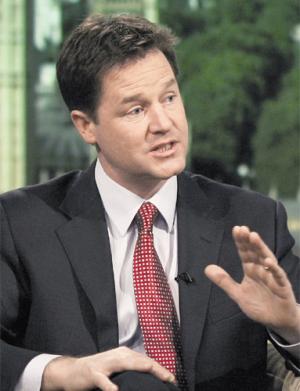
Over the weekend we had the pleasure of watching Liberal leader Nick Clegg (pictured at Conference) trying to woo Green voters over to his brand of neoliberalism and "savage cuts". As you might imagine, this isn't an argument that holds a lot of appeal around here.

Taking it at face value, shouldn't he should be attacking Labour or the Tories instead? If you're claiming, however absurdly, to be as green as the Greens, those two parties have plenty of egregiously anti-environmental achievements to criticise first.

When the initial outrage at Clegg's approach faded, it reminded me of the old cliché: first they ignore you, then they ridicule you, then they fight you, then you win. 

Are we in phase three already, from the Liberal perspective? The evidence around the world certainly is that Liberal parties (other than explicitly right-wing ones like the FDP) decline as Greens grow.

But of course it's not even about picking up actual Green voters. There's no-one out there who's decided to back the Greens but who somehow never considered voting for what a friend calls "the shark-infested custard". Those votes aren't coming back this side of some unimaginable Green implosion.

What this type of "lovebombing" really says is "I am more like them than you think". Clegg himself came under similar but more plausible pressure from Dave Cameron on the same day. As Jim Jay puts it, "should we then pick on someone smaller than us and attempt a similarly vacuous courtship?

In Cameron's case it's a good message because he knows the Liberals are, fairly or unfairly, seen as cleaner than the Tories. And here you will find me agreeing with Dave: there is indeed barely a cigarette paper between the Tories and the Liberals on many of the major issues he raises, so you can see why he's doing it. It's also a version of the irksome Lib Dem barchart-type squeeze on their votes.

In Clegg's case, he and Vince want to take the party to the right but don't want to pay the price for doing so. Appearing to cosy up to the Greens therefore shores up his left flank internally. It's those who might come over to the Greens over the next year he's really worried about, people who can't swallow the kind of Orange Book dogma that leads Vince to want to part-privatise Royal Mail.

If this kind of approach was a real attempt to squeeze other parties' votes, then the BNP would surely find themselves a prime target. All the other parties object to their vote growing, so they say, even if Labour and the Liberals apparently preferred to see Griffin win than see a Green MEP returned in the Northwest.

Imagine for a second any other party making an explicit appeal to BNP supporters in the same way, though. It won't happen, because the message it sends is "we're a bit more neo-Nazi than you think". Not even UKIP want to get down and dirty like that. Instead the three parties of the soggy Westminster consensus just give the infamous dog whistle an occasional blow, even the Liberals, sometimes

Incidentally, the BBC also got a failing mark during this weekend's shenanigans. Their web team posted an article saying "Green Leader Nick Clegg blah blah blah" (saved for posterity here, now updated here). 

No thanks. If he has a road-to-Damascus conversion to true Green politics, though, I'm sure my friends down south would be happy to take him as a member.
kensarowiwa.jpg
This morning Nick Clegg promised "savage cuts" to public spending, and by nightfall it was becoming clear they would fall at least partly on students. Well, it's not a cut to abandon a spending pledge, but it will certainly feel like one to students and would-be students.

Apparently the pledge would cost "billions every year". When Charlie Kennedy was promoting the idea, though, the price was just £700m a year. At least one Liberal leader is clearly lying here, unless the cost really has trebled since then. Thank goodness they worked with us and the Nats at Holyrood to abolish fees last year - just in time, it seems.

Seven months ago Clegg was on the record confirming their commitment to abolish fees in England and Wales. In February he said he knew "that young people will be hit hardest by the recession". What can have changed? 

The mood at Westminster is what. The big boys are having a discussion about cuts, so he's got to join in. They're equidistant from Labour and the Tories in principle, however contradictory that may be. If both those parties are tacking to the right and preparing to slash services for the poor, he'll have to be right in the middle of it all.

Despite today's foolish (and politically inept) decision, he went on to claim that they'll go into the next election with "the best, most progressive package for students of any mainstream party". What?!

It's obviously too painful or strategically inadvisable for a Liberal politician ever to admit that the Greens and the Nats are mainstream parties. This is a stunt they pull with tiresome regularity, and I'm sure a hundred years ago they were doing it to Labour. Sometimes the media play along, as with this example on Trident

Again, neither the Greens nor even the elected Government of Scotland count as mainstream by this logic, despite Trident being based in Scotland. In another instance they even claim to be the only mainstream party consistently concerned with civil liberties

This mantra about being the only "mainstream party" to oppose Trident, the Iraq War (which was a particular lie), tuition fees, etc, etc, simply decodes as a claim that Labour and the Tories are equally dire on these issues. Is that really much to crow about? 

My absolute favourite is this, though. "At the same we are the only mainstream party which continues to put the environment at the front and centre of our political massage (sic)". Leaving aside the unintentional honesty there (which will probably be fixed shortly), the gall there is extraordinary.

While the rest of the UK hasn't been governed by the Liberals since Lloyd George knew your father, we did have Liberal Ministers from 1999 to 2007, Ministers who made some of the most egregious and anti-environmental decisions taken in Scotland since the 1960s. Their specialities included motorway building and GM crop planting, alongside other hypocrisies like tuition fee renaming and ID card abstention.

Their 2007 manifesto had ten pages dedicated to the environment, although three of them were full-page photos of grass and snow and stuff. Surely this greenest of all the mainstream parties would have some achievements to cheer about from eight years in power?

Not much. In all this verbiage ("They may be only the tip of the morbidity iceberg") there are just two references to any actual achievements in this area:
* £20 million invested in "public sector energy efficiency"
* "recycling rates have trebled under the Liberal Democrats" (although what they did to achieve this wonder isn't stated)

To be fair, they did a bit better on funding marine renewables than their SNP successors, too. But, unlike the Romans, that really is the lot.

Contrast these baby steps with the massive expansion of the motorway network Liberal Ministers forced through. It's in the manifesto, albeit disguised as a pledge to "implement the current planned road infrastructure investment". Presumably they wanted us to believe it was just some minor frippery they happened to inherit.

For years I met English friends who genuinely believed that the Liberals had abolished fees in Scotland, and that they were like a more organised version of the Greens. Plausible, perhaps, if you've never been governed by them, if you overlook their lust for privatisation.

It won't wash in Scotland, though. I almost hope the English have to put up with Liberal Ministers. Perhaps then we'd start to see more pieces like this: the New Statesman's great exposé of Vince Cable, which points out he was just as enthusiastic a deregulator as those he now criticises. And that he was happy to work for Shell in the mid-1990s during the period they were accused of complicity in the murder of Ogoni activists (Ken Saro-Wiwa pictured). Enough said.

Death to the swingometer.

| | Comments (0)
swingometer.jpgReading the political coverage in the UK press, it's the same old same old Labour versus Tory cage-fight, with a bit of Tory-lite or Labour-lite in third place depending on who's in power.

The election's always decided by a handful of floating voters in a handful of swing seats, they say, and right now the story is they're switching to the Tories. Except they're not.

Polls rarely tell you anything about the churn. If Labour are down 2 and the Tories up 2, what's actually happened? Perhaps that 2% moved straight over, but it's unlikely. Maybe 2% moved from Labour to the Liberals, while another 2% moved from the Liberals to the Tories. Some will certainly have joined the Labour column, even in times like this. 2% in that scenario is just a net loss, after all.

The closest you normally get to this is polls that ask about switches since the last election. Earlier this week Comres did just that, and the Independent reports the results here. More than a third of Labour's 2005 voters are now going to vote for another party, and of those, more are now voting Green than have gone Tory. 

It makes sense: the disillusioned are likely to be those who wanted Labour to renationalise the railways or to stay out of foreign wars, and why would they switch to the Tories? It matters, too. If Labour are losing more votes to us that they are to the Tories, shouldn't they change their right-wing approach on these issues, rather than trying to stick to Blairism at all costs?

But this is a bit too complicated for most commentators, and for election night coverage too. Stay tuned for discussions that still feature that tired old swingometer. It's easier than reporting a true multi-party system.

Your Links At Last

Greens

Other Politics

Media

Environment

Friends and Stuff I Like

If I've forgotten to link to you, let me know. If I don't want to link to your blog I'll pretend I never got your email.

About this Archive

This page is a archive of recent entries in the Westminster category.

Transport is the previous category.