Perspective, people, please.

| | Comments (0)
Thumbnail image for blakewoad.jpgAnother extraordinary round of cybernat activity is drawn to my attention, this time on an article about Holocaust education. For some reason, there are people out there who believe that the Holocaust (6m+ dead, less than 60 years ago) is less relevant than Glencoe (78 dead, more than 300 years ago):

"The killing of million of Jews is abhorant and a dark shadow on modern history. However, the Clearances and the Glencoe massacre has more of an effect on our (Highlands, Islands and MacDonalds) pyschie than Aushwiz, if you see what I mean." - Dave from Barra

No, Dave, I don't. I don't believe you're speaking for the whole of the Highlands and Islands, either.

One Richardinho (rumoured to work at Holyrood, and certainly an SNP supporter) dismisses the death camps as "Polish history". 

"the 'most vital history lesson of all' for Scottish children would be to learn about Scottish history, not Polish history."

Others compare the Nazi exterminations to Culloden, a battle lost by an incompetent Jacobite leadership to the "Duck of Cumberland", a man so odious that one ex-pat in the thread refuses to eat Cumberland stew despite knowing there's no connection.

"It might be more appropriate to take Scottish school children on a tour of areas of concern to Scottish history including, for example, the battlefield of Culloden; there to be told of the butchery of the Duck of Cumberland. Visits to the likes of Auschwitz have no more relevance to Scottish school children than would an educational tour of the Siberian gulags where Stalin butchered millions of his own people; or to the killing fields of Cambodia or the sites of mass graves in the former Jugoslavia." - Guga II

Before the woad-covered backlash begins, yes, I am aware of the barbarism that followed Culloden. But no, I don't think there's much that can be generalised from the conflicts between the Jacobites and the Hanoverians, whereas Cambodia and the Balkans do illustrate the fact that genocide and ethnic cleansing are a continuing risk. 

Most disturbing of all, perhaps, is the comment near the end (yes, I read these things so you don't have to) about the picture associated with the article, which shows Auschwitz inmates looking insufficiently gaunt for one "Brage", the prime denier in this thread. He notes that:

"Incidentally, the photographs at the begining of the article does not indicate that the purported inmates were starving!"

Words fail me. I do hope we're not really condemned to repetition.

"Dear all.."

| | Comments (1)
junkmail.jpgAs Jim Murphy takes over another of Labour's poisoned chalices as Secretary of State for Scotland, a role formerly known to the SNP as Governor General, a story comes back to me from 1997. 

The source is long forgotten, and it may be rumour, so take with a pinch of salt.

Apparently Mr Murphy, newly elected for Eastwood to everyone's great surprise, arrived at the Commons to find its practices and procedures a touch too stuffy for his taste. He therefore, so the story goes, wrote to all MPs inviting them to discuss options for modernisation with him. 

Tam Dalyell was reported to be particularly appalled by an absurd invitation to take part in a process chaired by this young know-nothing with a few weeks' experience of Parliament. And no, nothing ever came of it.

No love for Ian Blair.

| | Comments (2)
jeancharlesmemorial.jpgThe leftish blogosphere is roiling with misplaced sympathy for Ian Blair. For example, Douglas Johnson, whose writings I usually like, says: "when a politician clearly edges a public servant out of their job, we should worry."

Elsewhere it's argued that "another block has been removed from the foundations of our weak democracy." The Guardian calls it a Tory plot.


Ian Blair ran the police force which through gross incompetence and carelessness killed Jean Charles De Menezes, and he fronted up one of the most disgracefully misleading media campaigns ever, promoting lies about the innocent Brazilian's actions that morning. Blair should have resigned that week.

I believe it was one of Livingstone's major failings to be so supportive of his police chief (along with the stuff about the concentration camps, naturally). Even this week he's still getting this wrong, because he's understandably miffed about the election. 

Note to the left: my enemy's enemy is not necessarily my friend.

Inside the tent.

| | Comments (1)
TonyBlairPeterMandelson.jpgPeter Mandelson, New Labour's original turbulent priest, back in the Cabinet? The cursing of the Brown loyalists will be long and heart-felt - this is a bold move to say the least.

It's not just those resignations, either (one, passports for domes, two, loans for curtailing investigations). It's the years of hatred and mistrust. Eighteen months ago, as Gordon Brown was preparing to take office, Mandelson was forced to tell Brown that he couldn't be sacked by the Prime Minister-to-be from his EU Commissioner post. 

Just six months ago Brown told him he could stay on in the Commission, and while the Guardian claimed "they are getting it together again", no-one believed them. These two have been against each other since the time Mandelson backed Blair over Brown for the leadership, and there is no way this will be smooth. 

I wonder if the bookies have offered odds yet on his next resignation. I believe resigning from Cabinet three times would be an all-time record.

The following fell into my lap through some kind of wormhole in the space-time continuum. It claims to be an article from the Scotsman, dated Friday 3 October, two days from now.

kennymacaskillsad.jpgThumbnail image for kennymacaskillsad.jpg
HOLYROOD STOPPERS ALCOHOL BAN

The Scottish Parliament yesterday delivered a stinging rebuke to the SNP administration on their plans to ban under-21s from Scotland's off licences. Despite passionate pleas from the Justice Secretary Kenny Macaskill, a Tory motion rejecting the plans was passed with support from all three other opposition parties.

Tthe Conservatives' spokesman Murdo Fraser said: "We all accept that Scotland's communities do indeed face problems with violence and disorder related to alcohol abuse. However, this hare-brained scheme from the SNP would fail to deal with those issues while simultaneously creating a whole new set of problems."

Defending the proposals, Kenny Macaskill urged Holyrood to consider the "extraordinary benefits to communities" that trial programmes have led to in West Lothian, Fife, and Central Scotland, brushing aside concerns about the evidence from those trials. He said: "Other parties oppose these plans, but have nothing to put in their place. If they fail to back us, they will face the judgement of the people of Scotland."

Speaking for Labour, Richard Baker, a former student president, said: "The real problem with licencing is the failure to implement existing legislation effectively, and whatever the question is, criminalising increasing numbers of young people is the wrong answer."

Green MSP Patrick Harvie described the move as "a misguided and ill-conceived idea, designed to get headlines rather than to find solutions", and urged the SNP to look instead at local measures based on the Local Licencing Forums introduced in 2005.

Long before the vote was taken it was clear that the Parliament would reject the Scottish Government's proposals. SNP backbenchers rose one after another to condemn the opposition parties as irresponsible and isolated from their electorate, with their attacks becoming increasingly shrill and combative, but in the end the motion passed by 80 votes to 47, with one abstention.

Welcoming the vote, Tom French, coordinator of the Coalition Against Raising the Drinking Age in Scotland (CARDAS), said: "This vote has to be the death knell of this profoundly illiberal and disproportionate proposals. Students and young people across the country will be, in a responsible manner, raising a glass to the sensible majority in Parliament."

BACKGROUND

Kenny Macaskill is himself no stranger to drunk and disorderly allegations, having spent the 2000 England-Scotland match in a police cell, but has since repositioned himself as the scourge of alcohol-related disorder.

With his populist attacks on two-for-one deals, and his description of Tennents as "cooking lager", he has sought to claim ownership of on a issue which has long been neglected by politicians at local and national level.

The SNP administration believes this idea would resonate with communities with experience of the misery caused by drunken young people. However, it came with a clear price tag - it's hard to imagine a policy more likely to upset student activists and other young voters.

This is the real reason Parliament has called time on the SNP proposals, which seemed inevitable once concerns about the methodology behind their pilot projects had been raised. Whatever Ministers say, Scotland's 18-21 year olds can be assured that their freedom to drink is safe for now.

Some advice for Werner Faymann.

| | Comments (2)
austrianresult.pngThe Austrians had yet another election yesterday, and it wasn't a pretty sight. Just like Germany, the centre-left and centre-right were in a grand coalition, and if I were in the German SPD or CDU I'd be looking over the border in alarm.

The equivalent centrist parties are down, although they are still the largest parties. Depressingly, the main winners were two extreme rightwing groupings. There's also a strong Green vote, just short of 10%.

There are also, unusually for Europe, no leftists and no liberals, which reduces the options significantly. The results are above - click for a larger image.

92 seats is a majority, and the permutations are grim. Again, a grand coalition is the only way two parties can get to that number. There are no other options to make a majority without the hard right, and for the centre-right to make any other majority they'd need both lots of extremists.

Anyway, it's a mess. Werner Faymann is the social democrat leader and the likely Chancellor, and there's an obvious way out for him - minority government. The Greens will be sensible ad hoc partners, and on budgets and other key legislation he'd need to woo the centre-right. 

There is a silver lining - the two extremist parties hate each other, and may well vote opposite ways just to spite each other. Sometimes they will win votes, sure, but only if they overcome their animosity to each other, and bring the centre-right in as well. 

It's the only answer to a grim question. Come over, Herr Faymann, have a chat to Salmond and see how you too could learn to stop worrying and love minority administration.

Update: my calculations above were wrong, and the SPD could get to 93 seats with the FPÖ - that's the only other two-party coalition that could work. Except for the ideological gulf, of course.

All rights reserved.

| | Comments (0)
highlighter.jpgWhile searching for a particular response to our 2007 manifesto, I found an interesting document published under FOI - a review (580k pdf) of that manifesto by a Scotland Office civil servant. 

Specifically, it's a "Selection of material focusing on those aspects of the Manifesto which could impact on relations with the UK Government and the pattern of the Devolution Settlement."

The highlighter pen got quite an outing. Tackling climate change and airport expansion, opposing nuclear power and nuclear weapons, and reversing rail privatisation all got blue-inked, and that's just from our key pledges. 

Some of these are understandable, especially nuclear weapons. But airport expansion in Scotland is a planning matter for local authorities, Scottish Ministers, and the Parliament. And why did the regulation of supermarkets not get highlighted? Or the defence of civil liberties? Given Westminster leads on the abolition of civil liberties you might have thought otherwise.

Anyway, I was interested to see what they made of us. And it turns out it's not just the radical Greens who had The Treatment. The equivalent exercise was also conducted on the SNP, the Liberals, where the author speculates fruitlessly about coalition, those dangerous constitutional rebels, the Tories, and even the Scotland Office's supposed friends in Scottish Labour.

Impact on relations with the UK? We all do it, apparently. And now you know a little more about the constructive way the Scotland Office spends its time.

Agreeing with the Republican right.

| | Comments (2)
jokerburnsmoney.jpgI don't think I've ever done that before. Let's see: war, homophobia, racism, climate change denial, fraud, hypocrisy. Nope, never agreed with them on any of that. Yet the $700bn plan to nationalise US banking losses put Obama on the wrong side, backing Bush despite the cost to his own plans, while the only congressional opposition came from the Republicans, specifically Senator Shelby, who said:

"What troubles me most is that we have been given no credible assurances that this plan will work. We could very well spend $700 billion or $1 trillion and not resolve the crisis. Before I sign off on something of this magnitude, I would want to know that we have exhausted all reasonable alternatives. But I don't believe we can do that in a weekend."

Now, they've got absolutely the wrong end of the stick about the plan. Republican Senator Jim Bunning said the plan was "financial socialism, and it's un-American". I always thought socialism was about giving money from the rich to the poor, not the other way round as per the Bush/Paulson/Bernanke plan, but perhaps I misread Uncle Karl. While their specific concerns are not the same as mine - 180 degrees away, in fact, given my sympathies are with this lot - the conclusion was the same. This plan is bonkers and it won't work.

But now even the Republican opposition has collapsed - presumably they finally worked out that the plan was a massive give-away to their pals - and it'll all go through. Will the credit ratings agencies now do what they'd do to anyone else picking up these toxic debts, and mark down the US Government for the first time from AAA? If you're looking for signs of the impending end of the American imperial phase, that would be a pretty clear one.

Incidentally, over here, the New Labour response is as weak and captured by the markets as the Obama response. Will Hutton wrote today, backing the scheme, that "Once again, the left is coming to capitalism's rescue". Is this a model of capitalism the left should really want to rescue, even with his sea of caveats?

Brown's response was also a mass of absurdities and inconsistencies. He decried the "age of irresponsibility" which he himself has sponsored, then in the next breath said:

"I have told President Bush today that facing global turbulence Britain supports the US plan. Whatever the details of it, it is the right thing to do."

Isn't it irresponsible to support a plan like this irrespective of the details? It's the classic failed politician's response, and it goes like this. Something must be done, and this is something, therefore this must be done. We should perhaps be grateful that this time he's not recommending wasting our money. Nevertheless, this whole scenario feels as though the Joker or the KLF have been put in charge of the global banking system.

Cracking down on nuisance callers.

| | Comments (0)
phoneangry.jpg
I don't have a landline, but a pal who listened to the first 5 seconds of her Clegg-call before slamming it down (previously discussed here) points me to this decision blocking their quasi-survey masquerading as market research. 

They now have to quit this no-doubt expensive operation or face prosecution, no matter what their activists would like to believe.

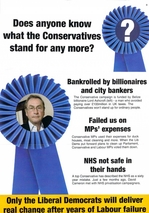
I got a leaflet through this week from them which worked on a similar basis, offering dubious choices on environmental policy for the party to misuse in subsequent press releases and attempting to harvest my email and mobile number. 

Why would such a questionnaire exclude options like opposition to Edinburgh airport expansion, or support for congestion charging? Only because they appear not to trust their arguments to actual debate on the issues. As a friend asked last time I wrote about this: "Why has it taken people so long to tumble to the Lib Dems?"

Internet and real life converge.

| | Comments (2)
The debate about the demise of capitalism banking crisis now plays out partly online, as one would expect, given the scale of the problems. The $700bn US bailout plan may unravel, and the Wall St Journal claims 'Wall Street' no longer exists (fancy a namechange then?). As Joe Stiglitz put it to the Today programme earlier this week, "they've now found a sucker, the American taxpayer, to take [these debts] off their balance sheet". The Lloyds TSB acquisition of HBOS may now face opposition too, although the scandal is less obvious and the opposition more muted. 

People get bored by the technicalities of banking and finance - I know I do. But these deals have one thing in common: the bankers get let off the hook, and the public loses out. In the first case, the US Government's "bad bank" would use taxpayers' money to pay off Wall Street's gambling debts (as MacWhirter noted), and in the second case Lloyds gets to waive competition law to snap up HBOS.

In the face of all this turmoil, the Americans have at least got their internet-related satire working much more effectively than us. First, in the spirit of the FAILblog, I give you Henry Paulson and Ben Bernanke giving evidence on their massive gift to the rich prudent measures to restore confidence in the banking system:

failbernanke.jpg
Next, here's some pseudo-spam that's been going round. Thanks to Aaron for the spot.

From: Minister of the Treasury Paulson
Subject: REQUEST FOR URGENT CONFIDENTIAL BUSINESS RELATIONSHIP

Dear American:

I need to ask you to support an urgent secret business relationship with a transfer of funds of great magnitude.

I am Ministry of the Treasury of the Republic of America. My country has had crisis that has caused the need for large transfer of funds of 800 billion dollars US. If you would assist me in this transfer, it would be most profitable to you.

I am working with Mr. Phil Gram, lobbyist for UBS, who will be my replacement as Ministry of the Treasury in January. As a Senator, you may know him as the leader of the American banking deregulation movement in the 1990s. This transactin is 100% safe.

This is a matter of great urgency. We need a blank check. We need the funds as quickly as possible. We cannot directly transfer these funds in the names of our close friends because we are constantly under surveillance. My family lawyer advised me that I should look for a reliable and trustworthy person who will act as a next of kin so the funds can be transferred.

Please reply with all of your bank account, IRA and college fund account numbers and those of your children and grandchildren to wallstreetbailout@treasury.gov so that we may transfer your commission for this transaction. After I receive that information, I will respond with detailed information about safeguards that will be used to protect the funds.

Yours Faithfully Minister of Treasury Paulson

Chocks away.

| | Comments (1)
balloonchair.jpgLembit Opik does love his odd modes of transport, most recently embarrassing his party with a stunt on a Segway

Previously, he used to give the Liberals that other-worldly touch with his obsession with asteroid strikes, prevention thereof. I always suspected he wanted to go on the spaceship himself for that mission.

Today he turned up in Fife to back their local candidate from the cockpit of a plane, presumably to get the message across that Liberals back aviation, not carbon cuts. Or perhaps to try carpet-bombing the residents of Glenrothes with leaflets that say "Only the Lib Dems can win here", which would be just as accurate as usual.

One curious thing, though, is that the release says he was "behind the wheel" of the plane, presumably his Mooney M20J. I am not an expert, obviously, but I think the word here is "yoke".

It looks like one or two of his colleagues would rather he tried the balloon chair (pictured), though, unless there is in fact a genuine campaigning reason why he's resigned tonight.

In praise of.. Ecuador.

| | Comments (1)
sealion.jpgIt sounds like tree-hugging taken to the next level - rights for forests, rivers, and even air? 

Yet this constitutional proposal before the Ecuadorian people promises exactly that (detailed wording here), to help Ecuador take on the multinationals who currently use the rivers as open sewers for their industrial waste, amongst other egregious behaviour.

Ecuador has extraordinary natural riches to protect, including the various iconic inhabitants of Galapagos (like the sealion cub pictured above). Constitutional rights might not be the most immediately obvious way to deliver those protections, but it's an interesting idea, and I hope we get a chance to see how well it works.

Second class response.

| | Comments (2)
shutletterbox.jpgSome three weeks ago Robin put down a motion here which invited the Nats to offer to bear the cost of loss-making post offices, and to recognise the essential social role they provide. Currently just one other MSP has signed it, and you won't be surprised to know it's Patrick.

Next time you find yourself listening to an MSP from any other party blathering on about saving their local post offices, ask them why they didn't sign up to the only proposal yet that would have saved the lot in one go. I'll tell you why, though. It's a dirty little secret.

These people actually love post office closures. At the Meadows Festival, it's all the Liberals wanted to talk about (although I insisted they talk about airport expansion). A threatened closure is a perfect campaign opportunity, a way to get local members motivated and to get into the local media. The printers here on the fourth floor whirr with little else.

The scandal is that they don't want to fix the problem, and one way to tell is that they only want to save the specific ones in their constituencies. I don't know about you, but I sometimes find myself in other parts of the country wishing there was a post office too.

Some are more hypocritical than others - and yes, Nigel Griffiths, I mean you, because you did vote for closures and then you campaigned to save them. But the same lack of an alternative applies to Liberal, Tory and SNP campaigners. As far as I know, anyway. Perhaps they've got a great plan - I know the Liberals considered privatisation, which would be one sure way to get as many closures as possible in the shortest time.

The bottom line is this. If they don't sign the motion, and they don't come up with an alternative of their own (which I would love to hear), you can tell they have no interest in fixing the problem, and just want to profit from the consequences. 

If they sign up, we could build a common campaign, and make post office closures a thing of the past. For instance, 43 closures were announced today, and Jamie Hepburn railed against them. Sign the motion, Mr Hepburn, start the ball rolling, then we'll know you're serious. 

Representation or aspiration?

| | Comments (0)
I like this anti-McCain impromptu jpeg below, but then again I am not exactly the target audience. Might the cult of material aspiration in the States blunt what seems like an obvious message to the likes of me? Given that folk buy into that attitude elsewhere, at an emotional level, might they not do so in an election as well? The test would be: how did Diddy's shout out to his brothers and sisters in Saudi Arabia for cheap oil for his private jet go down?

mccainobamahouses.jpg

Motivated Greens.

| | Comments (0)
firstplacepig.jpgA poll in yesterday's Independent On Sunday asked, as usual, how likely people say they are to vote (p5 here, 125K pdf). The keenest voters? Greens (average 9.31/10), then SNP and Tory supporters (9.19/10). 

Surprisingly, perhaps, Liberal voters (8.88/10) reported as least likely to get out, behind Labour (8.91/10). 

I'm not sure why, but my guess is distaste for Clegg's promise to cut taxes'n'services. 

The headline figures aren't as good for us, sure, but it's a firmer starting point.

Boombastic.

| | Comments (0)

In case anyone at conference was wondering why I looked distracted this weekend, it's because I had this specific song as an earworm. It's DJ Zebra mixing Shaggy and Rage Against The Machine, in case you're not down enough with the kids to tell that straightaway.

Prepare to be boarded.

| | Comments (0)

Today is, as you landlubbers have no doubt forgotten, International Talk Like A Pirate Day. By what is nearly an extraordinary coincidence, Parliament was yesterday discussing buccaneering of another sort. Here's Patrick challenging the consensus:


If you want to go a bit further back and look at what happened to our old mutuals, this educational film by Terry Gilliam really is the best summary. It also sets out how the fightback might look.


Part 1, Part 2 below.

The title, incidentally, is my favourite pirate chatup line.

Conference beckons.

| | Comments (2)
sgpconference2008.jpg
If you're thinking of coming and haven't booked, it's not too late. Details here.

Financial mathematics.

| | Comments (1)
bankmaths.jpgIn the beginning, there was the Bank of Scotland, the Halifax Building Society, Lloyds Bank and the Trustee Savings Bank (wikipedia links). In 1994 Lloyds took over the TSB, and in 2001 the Bank of Scotland took over the Halifax. Now, all four are one megabank.

Both these original mergers saw high street banks take over organisations which had begun as very different beasts, operating on less purely commercial lines.

155 years ago, the Halifax began as an extremely prudent building society, operating "for the mutual benefit of local working people". In the mid-90s the lure of unsustainable profits proved too much for the Halifax, and £19bn of wisely-saved assets were just given away during the demutualisation. 

This was the beginning of the end of Halifax, and just four years after it was floated on the stock exchange, it was swallowed up by the Bank of Scotland. I know it's unfashionable in Scotland to care about what happens south of the border, but at the time it was clear that the town of Halifax had lost a substantial asset, as had the working people who were the original intended beneficiaries.

The TSB, for its part, was an aggregation of small savings banks, run by trustees along "democratic and philanthropic guidelines". By 1970 there were 75 such banks, holding the then substantial sum of £2.8bn in assets. In 1984 they were united by legislation, and the TSB became virtually indistinguishable from the other high street banks.

It took just eleven more years for this new more commercial entity to be swallowed by Lloyds Bank, although in this case a small element of the philanthropic guidelines were retained, as 1% of pre-tax profits still go to charity.

In both these cases, creative and prudent Victorian financial structures were gradually stripped of their purpose and their capital. Private and secure institutions floated on the stock market as the short-term gains from speculation, massively leveraged loans and exotic derivatives grew more appealing. 

The depositor was essentially forgotten, and these banks competed to throw more and more money they didn't have at the mortgage sector, before trading these worthless debts as if they were actual assets.

Looking at the latest merger, it's dependence on exactly this money-go-round which caused the collapse of HBOS. Lloyds was a suitable buyer precisely because it had retained far more prudent approach to the secondary markets.

Personally, I am convinced that there are clear models we should pursue if we want to see a sustainable future for financial services. First, there are still building societies. The Nationwide in England may be the largest UK-wide, with £159bn of assets, but we have our own mutual stars like the Dunfermline Building Society. There's definitely room for more.

Second, there are banks we will surely never see a run on, prudent organisations which invest in society and which rely on deposits, not inter-bank lending. The Cooperative Bank and Triodos are the two most obvious examples. The Royal Bank of Scotland would be well advised to get on board with this more sustainable model as quickly as possible (and, while we're on the subject, to reject schemes like Sakhalin 2), although I know it'd take a massive amount of work to do so.

Thirdly, we are seeing a small rise in the role of credit unions, which operate in line with many of the original social objectives of the building society movement. 

In the longer term, if we have institutions which are based on this limited element of Victorian values, we will be able to weather these storms. They're traditional Scottish principles, too, as Patrick pointed out at First Minister's Questions today. Thrift, self-reliance, sustainability, and even prudence. We'll be lost without them.

Update: here's what that ??? should look like.

Cyber anti-nat.

| | Comments (1)

I've long bemoaned the poor standard of discussion on newspaper websites, with slavish, abusive and irrational SNP supporters usually the main culprits. A challenger arrives today, though, on this Telegraph article (note: I hit the complaint button, so the comment may disappear). 

Now, plenty of cybernats use appalling comparisons, with Brown normally compared to Mugabe using the super-clever phrase "ZaNu Liebour", but this comment goes right to the classic idiot's favourite - Hitler. 


Thumbnail image for cyberantinat.pngIn case anyone's not familiar with Godwin's Law, the original states that as time passes in an online discussion, the probability of a Nazi analogy tends to 100%. More recently, it has been redefined to mean that anyone making such an analogy automatically loses whatever argument they're engaged in. I hope we can all agree that's what's happened here.

Note: I am not related to this particular "James", before anyone suggests otherwise.